
Early years
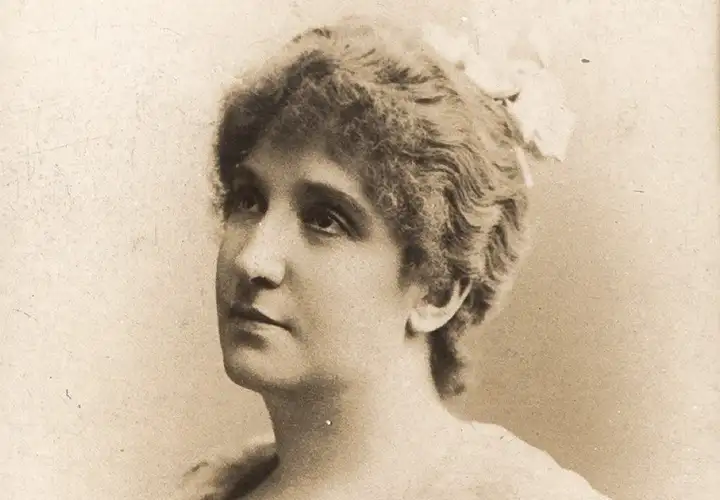
Helen 'Nellie' Porter Mitchell was born in Richmond on 19 May 1861 to David and Isabella Mitchell. The eldest of seven children, she attended Melbourne's Presbyterian Ladies' College (PLC), where she pursued her interests in piano and singing. As a teenager, Melba performed in amateur concerts throughout Melbourne as well as her church choir. After her mother's sudden death in 1881, her family moved to Mackay, Queensland, for her father's work.
Career
Melba's musical training began during her school years, and she worked hard to perfect it in the years following. After moving to France, Melba was trained by renowned singing teacher Mathilde Marchesi and launched her singing career in 1887.
Throughout her career, Melba conquered the stages of Paris, London and New York. She rose to prominence as the leading lyric soprano at Covent Garden from 1888, soon gaining further acclaim in Paris and across Europe. In 1893, she made her debut at the Metropolitan Opera in New York City, where she continued to achieve great success.
But despite her success abroad, she always considered Melbourne home. It is, therefore, no surprise that her stage name, 'Melba', was derived from her beloved hometown. Her first visit home after travelling overseas was in 1902 for a concert tour, which also included New Zealand.
Personal life
In Queensland, Melba met her soon-to-be husband, Charles Armstrong. They married in Brisbane on 22 December 1882 and had one son, George, in 1883. The marriage did not last, and the divorce was finalised in April 1900.
When revisiting Lilydale in 1909, Melba purchased a 60-acre property near Coldstream. After architect John Grainger's renovations and extensions, she bought the house and renamed it 'Coombe Cottage'.
Recognition
In 1901, Melba opened the Melba Conservatorium of Music in Richmond, which would become the starting ground for many young musicians.
When the First World War broke out, Melba was in Australia and quickly threw herself into fund-raising for war charities. In recognition of this, she was created a Dame Commander of the Order of the British Empire (DBE) in March 1918, "for services in organising patriotic work". This honour was elevated to the Grand Cross of the British Empire in 1927.
In 1926, Melba published her own singing tutorial The Melba Method and was the first Australian to appear on the cover of Time magazine in 1927.
Today, her portrait is featured on the Australian $100 note, and the microprint features excerpts from Melba's autobiography Melodies and Memories.
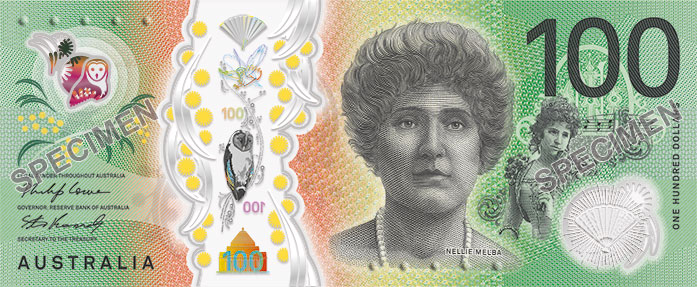
Dame Nellie Melba featured on the Australian $100 note. Source: The Reserve Bank of Australia.
Death
After a long illness, Dame Nellie Melba passed away on 23 February 1931 at St Vincent's Private Hospital in Sydney. She was 69 years old.
A newspaper reporting her death stated, "The news of her death will be received with sorrow by a world which for years had been enthralled by her marvellous voice."
Melba had a memorial service in Scots Church, Melbourne, which her father had built and where as a teenager she had sung in the choir. She now rests at Lilydale Lawn Cemetery. Her gravestone has words from the musical La Boheme inscribed, "Addio Sensa Rancor" meaning, 'farewell without bitterness'.