Said Ahmed Shah, a Muslim High Priest and hawker, lost his life during a dispute at Warburton on Sunday 2 April 1911.
Early years
We know little about Shah's early years, although he was born in India about 1867.
Career
Shah worked as a hawker, using a horse-drawn cart to travel the countryside and sell his wares. This was a popular trade for young men from central Asia. They could set up a business with few resources.
Most hawkers at the time were from India, like Shah, and many from the Punjab region. They filled their wagons with goods from Indian or Syrian traders.
The hawkers formed a tight-knit community, even though they travelled all over Victoria. While there were no mosques, religious centres were set up in Fitzroy and Carlton. The community celebrated major religious festivals in Fitzroy Gardens.
Shah was an important man in the tiny Muslim community in Victoria. He was a ‘High Priest’ at a time when there was no mosque and no permanent Imam. He oversaw religious duties in the absence of a trained Imam.
Death
Shah had been in an ongoing dispute with his neighbour, a farmer called John Polley. He accused the farmer of stealing from his property. He went to Polley's hut to question him, vowing not to leave until the farmer returned his goods. Polley’s son handed his father a loaded rifle and he fired, killing Shah. The courts acquitted Polley of the murder while the community mourned Shah's loss.
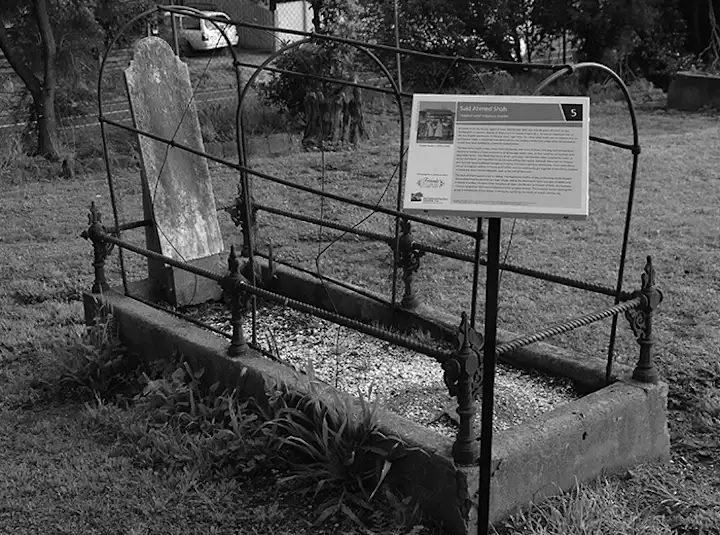
The style of Shah’s grave is worth noting. By Muslim tradition, the headstone itself is simple, showing only Shah's name and date of death.
The first of the 5 pillars of Islam, the Muslim profession of faith, the Shahada is written in Arabic:
‘There is no god but God and Muhammed is the prophet of God.’
The vault-like frame covering the grave signifies the vaults of heaven and the sky.
Bibliography
Adapted from material supplied by historian Dr Jan Penney, GMCT Trust member 2010-2020, and by the Friends of Coburg Cemetery Inc.
Deen H (2011) Ali Abdul v the King: Muslim Stories from the Dark Days of White Australia, University of Western Australia Press
Stevens C (1989) Tin Mosques & Ghantowns: A History of Afghan Camel drivers in Australia, Oxford University Press
Westrip J & Holroyde P (2010) Colonial Cousins: A Surprising History of Connections between India and Australia, Wakefield Press
Image source
Courtesy of Friends of Coburg Cemetery