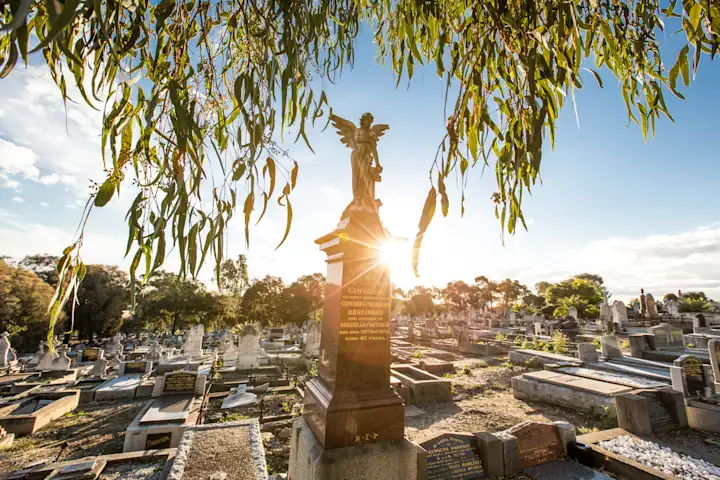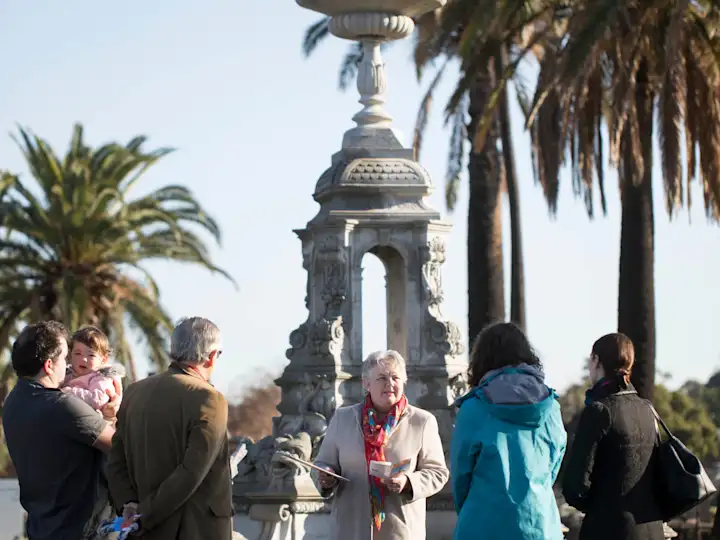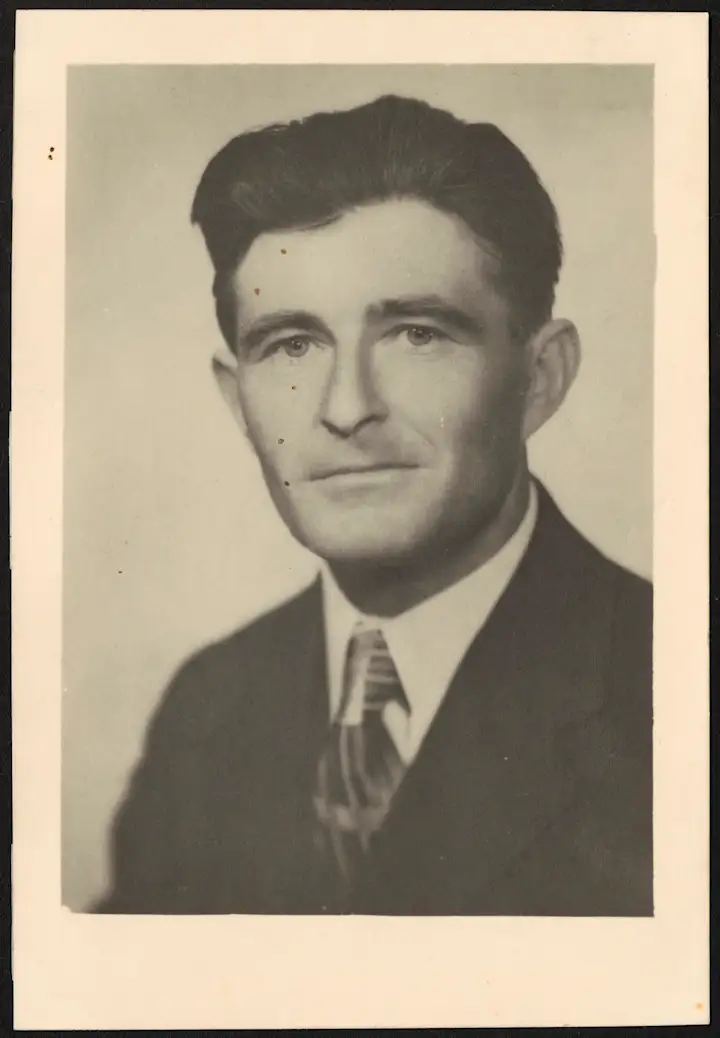
Learn about one of Australia's war poets, Edward Phillip Harrington. Edward is featured on the Extraordinary Lives part 2 tour, where you can also learn about other stories from Fawkner Memorial Park.
Learn more with our Discover Cemeteries app
Edward Harrington is one of the many stories you can hear when you Discover Cemeteries. Visit the App Store to download Discover Cemeteries and join us to hear the untold stories of Fawkner Memorial Park.
Watch a video about Edward.
Download a transcript of Edward's story from the Discover Cemeteries app.
Early years
Ted was the fourth child from a family of nine children. His parents, Phillip and Margaret, farmed at Shepparton in the Goulburn Valley. His sister later recalled that he wrote his first poem aged nine. He also often submitted verses to the local newspaper.
Military career
Ted enlisted in the army on 22 February, 1917 aged 21. He was in the 4th Light Horse Regiment and the army sent him to Egypt on the Boorara in May 1917.
Ted’s war record shows he was often ill and in hospital. He was well enough to take part in the charge at Beersheba on 31 October 1917 and the advance to Damascus. But he needed medical treatment for the rest of his life. Later, when he could no longer work, the army gave him a pension.
He was a sensitive and thoughtful man given to pondering the effects of war on the country. Many of his poems refer to the wartime sacrifices made by those in uniform.
After the war, Ted tried his hand at farming but went broke. He tried other types of work too but preferred his poetry.
Ted often complained in his poems that the society around him was not the one he and his mates had fought for. To keep the memory strong, he always wore an emu feather in his hat.
Recognition
Ted was a small man, standing only 5 feet 3 inches tall but his heart was much larger. His spirit shone in his verses and ballads.
His writings often reflected his life in the bush. He featured iconic Australian emblems like the swagman, the black billy and the bush in his work.
Ted wrote for The Bulletin and Labour Call. He was also a founding member of the ‘Lawson Society’ and ‘The Bread and Cheese Club’. These clubs fostered traditional forms of verse.
Many of Ted’s works such as ‘The Old Black Billy' were set to music and became popular. Australian singer Peter Dawson even made ‘The Bushrangers’ and ‘Lasseter’s Last Ride’ famous.
In many ways, Ted was the last of the traditional balladists. The Age called him ‘The Digger’s Poet’ in their review of his work in April 1952, quoting this verse called ‘Memories’ –
The sun will rise and the sun will set,
On minaret, mosque and tomb,
But the desert children will not forget,
The men of the emu plume.
Death
Ted, like so many other writers of his day, never made much money from his writing. He never married and died of chronic bronchitis and emphysema in 1966.
Ted is buried in an unmarked grave at Fawkner Memorial Park. However, he has a memorial in the Victorian Garden of Remembrance in Springvale.
Adapted from material supplied by historian Dr Jan Penney, GMCT Trust member 2010-2020.
Bibliography
Anon 1940, ‘Edward Harrington – Australia's Poet in Palestine’ Glen Innes Examiner, 23 July 1940, p. 7. Viewed from Trove [website]
Anon 1952, ‘A “digger poet” - Work of Edward Harrington’, The Age, 26 April 1952, p. 10. Viewed from Trove [website]
Bradley, P. 2016, The Australian Light Horse Campaign, Allen and Unwin, Crows Nest
Harrington, E. 1920, Song of War and Peace
Harrington E. 1944, The Kerrigan Boys and other Australian Verses
Image source
Image from State Library of Victoria.