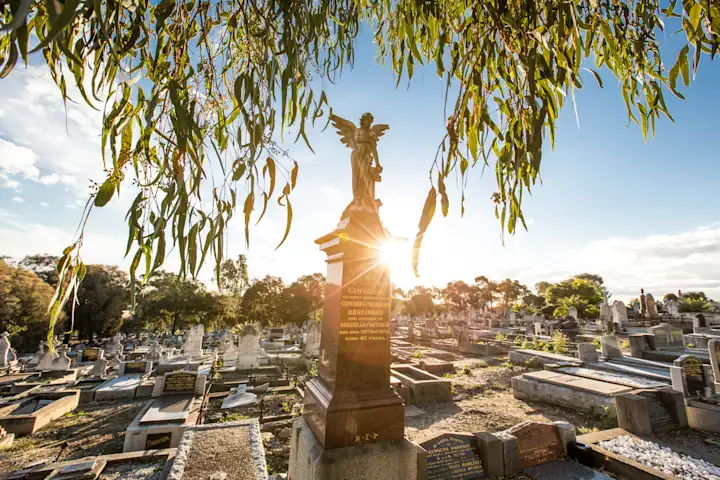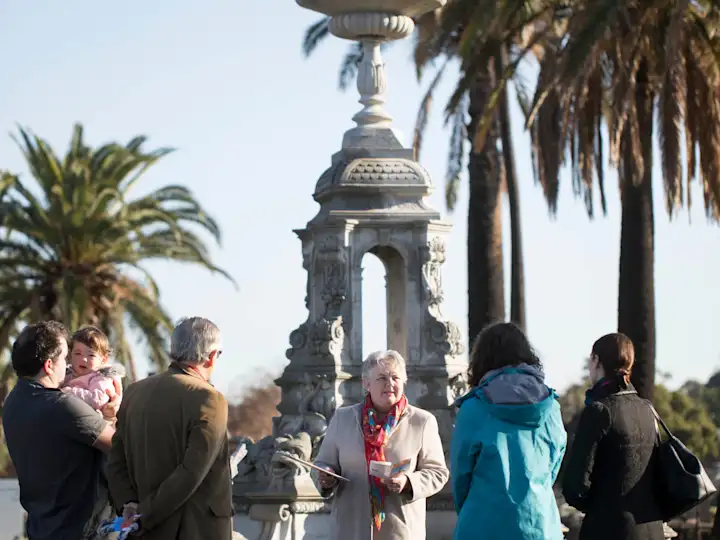
Meet Sundar Abdullah and learn about the life of the immigrant Victorian hawkers. Sundar is featured on the Extraordinary Lives part 1 tour, where you can also learn about other stories from Fawkner Memorial Park.
Learn more with our Discover Cemeteries app
Sundar Abdullah is one of the many stories you can hear when you Discover Cemeteries. Visit the App Store to download Discover Cemeteries and join us to hear the untold stories of Fawkner Memorial Park.
Watch a video about Sundar.
Early years
Sundar was born in Afghanistan and emigrated to Australia. Further details of his early life - and even his exact birth date - are unknown.
Career
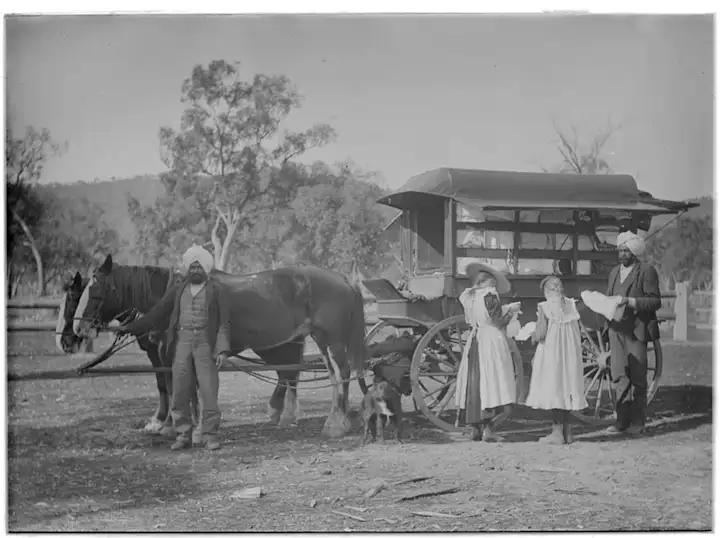
Sundar was one of the many hawkers who travelled around Victoria selling goods. He sold drapery, needles, thread and other household items to farmers on annual visits.
Many Australians may be familiar with the story of the Indian and Afghan cameleers. These men migrated to Australia in the 1860s with their camels to open up the outback. These cameleers, many of whom were Muslim, brought supplies to remote homesteads.
But some years later, a second wave of Afghan migrants arrived. Many of these second wave of migrants, like Sundar, became hawkers. Many hawkers were Indian Hindus and Sikhs, recognisable by their turbans. Others came from Afghanistan, Persia or Iran and were Muslim.
Major regional towns issued licences that hawkers needed to operate. By 1900 Melbourne alone issued over 300 licences.
A hawker cart business was a good start for a young man. These young men were often helped into business by older members of their community who lent them money to buy a horse and cart and the goods to stock it. The young men paid the loans back with interest.
The people of the sub-continent were familiar with the travelling hawkers. It was easy to continue this practice in Australia once they learned to speak English. They slept in their carts and had no accommodation costs.
There are few sources that tell us about Sundar's life. But newspapers at the time said he was Persian and educated in Constantinople, now Istanbul. He was of the Muslim faith, was fluent in Persian and Arabic and could read and write in English. His companions called him a ‘Mullah’- meaning a man of culture and learning.
Death
Sundar had retired to Melbourne some years before his death and led a quiet life of piety. After his death, two of his compatriots went to the city morgue to wash his body according to Muslim practice. They anointed his chest with charcoal and sewed a linen shroud around his body. At his graveside, other Muslims chanted prayers from the Koran as they laid his body to rest.
Adapted from material supplied by historian Dr Jan Penney, GMCT Trust member 2010-2020.
Bibliography
Anon 1950, 'Death at 107 years', Barrier Miner, 17 February 1950, p. 2. Viewed from Trove
Jones, P. & Kenny A. 2007, Australia’s Muslim Cameleers: pioneers of the inland 1860-1930, Wakefield Press, Kent Town
Rajkowski, P. 1987, In the Tracks of the Camelmen: outback Australia’s most exotic pioneers, self-published
Spennermann, D. (n.d.) Death and Cremations of Indian Hawkers in the Southern Riverina until 1952
Image source
Hawkers with customers inspecting their wares (ca 1901-1909). Taken from Charles Sturt University.